Clinic Terrain Intelligence · The Method

Clinical intelligence in Bali: software expands the review, a physician makes the decision.

Clinic Terrain connects dated clinical information, explicit validation checks, published scientific dossiers and physician review. The website does not claim an unseen software process as proof: the attending physician remains responsible for the clinical conclusion and plan.

For people who want to understand the clinical system behind Clinic Terrain's work in energy, brain fog, NAD+, peptides and cellular resilience.
Physician-led pathwaySuitability confirmed before treatmentEvidence boundaries published
Start a deeper clinical review →
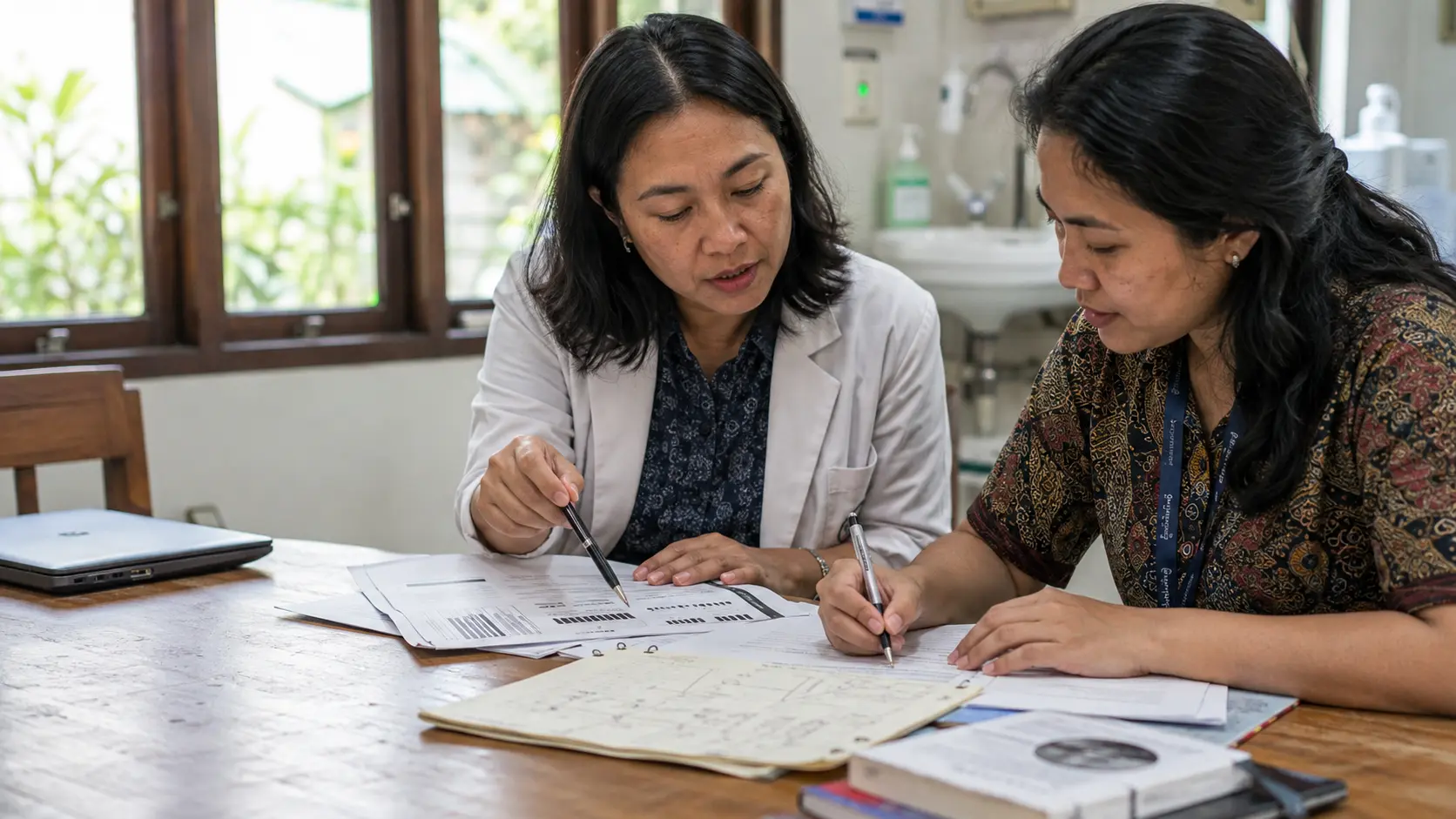
Two Indonesian clinical professionals examining a longitudinal record and handwritten notes
Reviewing symptoms and results over time.
Dated longitudinal record
Explicit validation checks
Published scientific dossiers
Physician-validated plan

The software cycle

More computational depth. More clinical accountability.

The platform increases how much of the case can be organised, checked and challenged. It does not remove the clinical gate. Every cycle returns to a named physician decision.

  1. 01CollectHistory, symptoms, medication, documents, laboratories and goals.
  2. 02ValidateIdentity, source, chronology, units, ranges and contradictions.
  3. 03ConveneThe relevant clinical perspectives are selected for the question.
  4. 04ChallengeEvidence, counter-evidence, omissions and disagreement stay visible.
  5. 05Physician gateThe doctor rejects, revises or validates the proposed clinical route.
  6. 06LearnOutcome and follow-up update the living record for the next review.
CLINICAL REVIEWOne traceable dossier · one accountable decision

Sources, contradictions, missing information and the physician's conclusion stay connected in the same review.

MEDICAL VALIDATIONHuman authority is the final gate

No one-click diagnosis. No autonomous prescription. No protocol without physician review.

01

Collection: your story becomes a traceable record

Read this stepClose this step

Conversation, symptoms, medication, documents, laboratory values, treatments and goals enter one structured dossier. Each fact retains its source, date, unit and context. The software does not flatten a person into a prompt: it preserves the clinical trail the physician must be able to inspect.

02

Deterministic rules establish the foundation

Read this stepClose this step

Identity, units, reference ranges, chronology, medication context and contradictions are checked through explicit rules. The same input follows the same validation path, creating a stable foundation for deeper clinical reasoning.

03

The question selects the depth

Read this stepClose this step

Coordination and simple operational needs take the fast route. Focused questions receive a bounded clinical review. Complex cases open a deep consultation across the full dossier, longitudinal reasoning and the relevant specialist perspectives.

04

Collective intelligence examines the same case

Read this stepClose this step

The software can convene the perspectives relevant to the question, including internal medicine, metabolic health, hormones, cardiovascular health, neurology, sleep, recovery, nutrition and medication safety. They examine the same structured dossier, surface different hypotheses and expose disagreements rather than collapsing immediately into one answer.

05

Structured monographs bring clinical depth

Read this stepClose this step

Structured clinical monographs connect mechanisms, human evidence, testing context, therapeutic options, monitoring and safety. The system retrieves the material that matches the clinical question instead of searching by popularity; publication counts are not used as a substitute for demonstrated coverage.

06

Evidence is challenged and reconciled

Read this stepClose this step

Supporting evidence, counter-evidence, contradictions and missing information are brought together. Specialist perspectives can be revised after that scientific review, producing a clearer set of priorities and decision options.

07

The record learns from your trajectory

Read this stepClose this step

New results, interventions, tolerance, adherence, symptoms and response update the living dossier. Follow-up begins with everything already learned and sharpens the next physician review.

08

The physician validation gate completes the plan

Read this stepClose this step

The physician receives the structured case, source trail, open questions, contradictions, priorities, monitoring points and proposed next steps. The doctor can reject, revise or validate them. No diagnosis, prescription or protocol is produced in one click: the final clinical plan and patient communication remain under physician authority.

One method · several valid outcomes

The clinical route does not end at NAD+.

The same decision method can lead to an infusion pathway, a molecule-specific peptide review, further investigation, longitudinal observation or no intervention. The objective and evidence choose the branch.

01 · NAD+

Infusion is one possible route.

Suitability, dose, setting, infusion tolerance and the outcome to observe must be defined before NAD+ becomes the plan.

Explore the NAD+ pathway →
02 · Peptides

Different peptides. Different medical decisions.

Retatrutide, BPC-157, MOTS-c and other peptides are not interchangeable. We start with the clinical objective, then assess the molecule, the evidence, the exact product and the monitoring needed before deciding whether it belongs in your care.

Explore the peptide pathway →
03 · Clinical foundation

Sometimes the next step is neither.

History, examination, medication review, laboratory clarification, referral or observation may be more useful than starting an intervention.

Explore testing and interpretation →

See the system work

From scattered information to one physician-ready decision.

This illustrative example shows the structure of the work. It contains no patient data and makes no treatment recommendation.

ILLUSTRATIVE CLINICAL RECORDSynthetic example · no patient data
01
Scattered input

“Low energy for three months”, afternoon decline, fragmented sleep, a medication list, two laboratory PDFs and a previous NAD+ session described as helpful for one day.

02
Deterministic validation

Every observation receives a source and date. Units and reference intervals stay attached. Repeated values are ordered chronologically; a result missing analytical context is held as incomplete rather than silently normalised.

03
Focused clinical questions

The system selects the relevant perspectives, sleep, iron and haematology, thyroid, glucose regulation, medication and recovery load, and asks which explanation fits the complete timeline.

04
Contradiction and evidence control

The reported one-day response remains a dated observation. Without a repeatable functional measure, it is not promoted to proof that NAD+ resolved the underlying fatigue.

05
Physician-ready output

Known facts, unresolved gaps, safety priorities, questions that could change the decision and a minimal follow-up measure are separated in a concise brief for medical review.

OUTPUTOne living record. One accountable clinical route.

Connected clinical library

The system behind the clinical decision.

Clinical intelligence, named medical oversight, editorial standards and one longitudinal record.

About Clinic Terrain→How care works→Medical team→Medical network in Bali→

Direct answers

The practical questions this page resolves.

What does deterministic clinical intelligence mean?

It means core checks such as identity, units, chronology, source and range handling follow explicit, repeatable rules before wider clinical reasoning begins.

Why use several specialist perspectives?

Energy, cognition, recovery and cellular health often cross multiple systems. The platform selects the perspectives relevant to the question and reconciles them around one patient record.

What is a clinical monograph?

It is a structured medical reference that connects a topic's mechanism, evidence, clinical context, testing, treatment considerations, monitoring and safety in a format the system can retrieve precisely.

How does follow-up improve over time?

Each relevant new event updates the same living record, allowing the next review to compare baseline, intervention, response and trajectory.

Does the software make an automatic clinical decision?

No. It structures, validates, retrieves, compares and challenges information. A physician reviews the source trail and contradictions, then rejects, revises or validates the final clinical plan.

What can be inspected

Each claim needs its own proof.

Accountability

Who stands behind this clinical information.

01 · Editorial ownership
Clinic Terrain Clinical Editorial Team

Prepared and reviewed on 22 August 2026.

02 · Medical accountability
dr. I Wayan Cahyadi Surya Distira Putra, MPH

Clinic Terrain Chief Physician. He leads the medical interpretation of mechanistic, longevity, NAD+ and peptide pathways. The attending physician retains authority over the final clinical plan for each patient.

Chief Physician profile →

Your first message · Where you are + what you need help with

Tell us what is happening. The team will clarify what matters and explain what comes next.

Start a deeper clinical review →WhatsApp intake open 24/7 · One-minute first-response target
WA